Blog

  • April

    It has been a few days since I finished Cormac McCarthy’s “Blood Meridian or the Evening Redness in the West .” The characters, the desert setting, the brutality of humankind but also the great lengths one goes for money and notoreity. Afterwards, I wasn’t sure what to ead. I certainly had no inquiry strong enough or fascination to read more of Cormac’s books. I think the contents of the book has made me veer more towards something benevolent and kind-hearted. Which is why I have made attempts to read Shantideva’s “The Way of the Boddhisattva” by Shambala publications. I think this in a way mirror’s my inner thoughts. I can talk about compassion, inner struggles, and international relations to people but I can also be exposed to depolorable, sickening, and antagonizing acts of depravity.People generally want something stable, a stable income, a stable moral support, and a stable personality. But stability brings repetition more often than not. And repetition brings conformity or boredom as all the neuron receptors think and do the same resulting in time going really fast. Going from age ten to twenty feels like decades but going from thirty to forty feels like a flash of lightning.

    It is fair to say March is truly March Madness in the eyes of basketball fans but also for Japanese schools. March is the month of finality. The end for educators and students and all in between, from special needs specialists to the custodians to the administrators like the principal and the higher ups. The best I can describe is it is a slow somber series of farewells both temporary and permanently. When March hit off, I did not treat it like an unique month. But things slowly changed. Instead of the usual five to six classes that I co-teach daily at the elementary schools and the single junior high school, it slowly went to four then three and sometimes just one or two, especially in the final weeks of March. The tounger students showed continuous interest and participation as usual but the sixth graders, the graduating class, slowly unveiled disinterest. The sixth graders are mentally preparing for middle school and the graduating middle schoolers are preparing for high school or college, whichever they end up choosing to go to. Before going further, I would like to further explain the Japanese education system to get a better understanding.

    Teachers in Japan are viewed as public servants. It is a respected profession and generally it is hard to let go a teacher unless something egrigious was done by the teacher. Once completing the required exams, they are decided by the prefectural board of education (BoE). For example, if the teacher is in Hiroshima prefecture, the Hiroshima BoE decides. You may be placed in the most remote regions of the north where the student population for the school may be in the double digits or you may be put in a major city where busses, trolleys, and foreigners take over the commuting space. Of course personal preferences with appropriate mreasonings like the distance of commute or the locality of their family or significant other is taken into consideration, but ultimately,your early career stage trajectory is in the hands of the high ups who themselves have been educators for twenty, thirty years or more. Just like being a cabin crew member for an airline, when you first start out, you are on call have to work the irregular shifts that cause baggy eyes and inconsistent sleep schedules. But through the years of service and allegiance, you gain doses of seniority and preferential treatment. Teachers in Japan, regardless if you are a first year or entering your fifteenth year into the career, get reshuffled every three to five years, because after all you are a public servant. You are going where you are needed the most. Though there are exceptions. A homeroom teacher I work with at an elementary school around the same age as me has been reshuffled a few times, though I am not sure of the precise reason(s). Or for example, a teacher with thirty years of experience and is one or two years shy of retirement will more than likely wan to finish out their reamining teacher years at the same school so perhaps the teacher will stay for more than five years. It all depends case by case but generally speaking, teachers stay for few years at one school before repeating the same cycle again at a different school. But why? At the core, it goes to the collective mindset. If school A has been performing low on the subject of math either due to poor execution of the curriculum or lack of enthusiasm from the math teacher and school B has amazing results, then during the reshuffling period (end of March), there is a plausibility that the teacher from school B will be at school A for the start of the school year in April. It appears that Japan wants schools to have fairness and equitability. New teachers bring in fresh pedagogy and different work styles. It strays away from repetition and redudancy while bringing the best quality education possible for the students.

    The graduation ceremony I participated on was a sunny Saturday morning for one of the elementary schools. Everyone brought their A game of suits and professional clothes. Ladies had the embroidery on their pockets while men had modest suits and stylish ties, albeit, it had to be white. Oh yes! You heard that right. White ties are specifically worn for graduation ceremonies and others. Black ties on the other hand are worn for funerals. My western mindset couldn’t fathom wearing a white tie on a white shirt. It was held in the gymnasium and the teachers and students up until this point, had done rehearsels religiously. They have mastered every movement and tone and breath. Watching from the sidelines shoulder-to-shoulder with other teachers, it was like watching a wave of people from the result of standing up, sitting down, and bowing down. And after an hour or so of honorary speeches from the higher ups, the graduating students with their respective teachers walked one by one through the gym. Equally spaced out about five feet apart, walking in a miltary manner, everything was orchestrated in perfection. I am not exactly going into the specifics of the ceremony but in general, the mood was somber and emotionally melancholy. It was only after everyone exited the gymnasium and retreated back to the school, that everything changed like the city street lights turning on once the sun had settled.

    Students and teachers were standing along the hallway like we were recording for a rap music video. Not too long after, the sixth graders, now in seventh, walked down the stairs and were cheered, applauded, and supported from classmates, former teachers, and advisors. The music, the confetti thrown up in the air, the young students trying to hide their tears, it was a melting pot of emotion that had been held in for too long and was finally cascading after months. In my K-12 school experience in America, nothing like this remotely happened. The only graduation I went to was for the high school, but no amount of rehearsals, preparations, and collective understanding of what was to be done came close. I ould see many of the students at the junior high school that I work at, so it wasn’t an eternal good bye… yet. As for the teachers, the same emotional roller coaster experience would start again the following week.

    We went back to the gymnasium. A lot less people compared to the student graduation ceremony, understandably so. The same procedure happened. In this school, close to fifty percent of the school staff, including a mixture of classroom teachers and teacher aids had quit, reshuffled, or retired. The eleven teachers gave their own personal speeches, received their boquet of flowers, said their goodbyes to the students and would say their final good byes before their next adventure. A teacher aid told me she was going to be a saty-at-home mom and take care of her two children. Another said that her husband is locating to a new city for work reasons and she will have to quit to reside with him for the next couple of hours. A classroom teacher, a respected one, after years, perhaps over two decades, informed me that they will be the vice principal at a school on a small island inside the prefecture of Hiroshima.

    What I got out of this is that though, deep down, teachers may not necessarily agree with the system that is in place, with the constant reshuffling or the bureacracy or the curriculum, they go with it. April is the start of the new school year, which means new students, new teachers, and new experiences which I am very excited for as I close my chapter of Japan in less than four months.
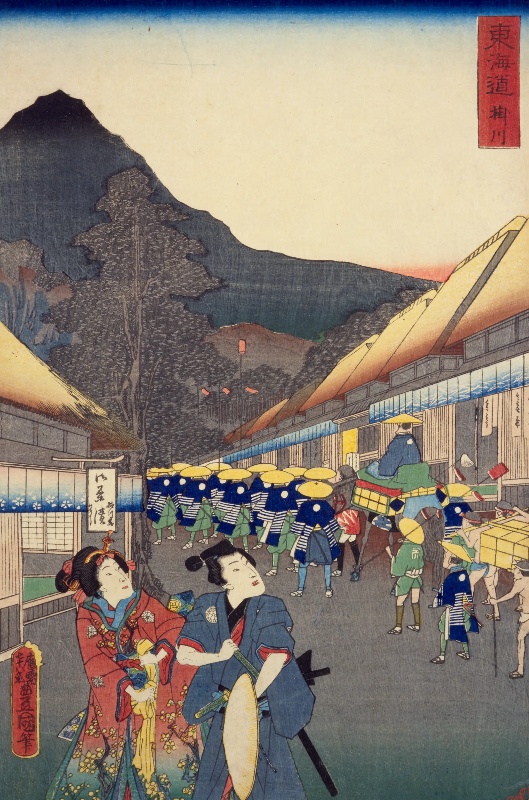
    “Tokaido Road, Kakegawa”  (NDL Gallery, public domain)

  • Day Before Graduation Ceremony

    It’s Friday, March 13th, 2026. The protein-packed beef bowl along with the cold soggy fries and the typical veggies and white rice sit comfortably in my stomach. I was starving to say the least, but the typical school lunch (kyushoku) in a Japanese elementary school measures around 600 calories. For my size, it is hardly considered a proper lunch but for the students, it is just enough to get them going for another four hours before walking an hour or more back home, depending on the student’s location. I sit in the teacher’s office while writing this blog. Doing a quick headcount, I see three, sometimes four or five depending on who’s rushing in and out to retrieve a textbook or make dozens of bingo sheets at the copy machine. The warm jet-stream-like flow of hot air breezing above my head circulating around the office reinforces a quiet but malevolent push to keep me drowsy. I think it’s working. Nothing to me matters more than a king sized bed and open window. 

    Behind me, the students are outside playing during recess. Some are playing dodgeball, while others are playing tag where one or two take on the role of a demon (oni). And a select few students wander just near the outskirts of the playground to explore. This all depends on the grade level of course. You rarely see different grade levels playing together. Maybe 4th and 5th or 5th and 6th do, but I just haven’t seen 3rd graders playing alongside with the graduating classes. For the graduating classes of the 6th graders, it is their final recess. The last recess before their graduation ceremony tomorrow and from there on, embark to junior high school where recess, heads up seven up, and just being a kid dissipate. I remember in 2010 when I finished fifth grade and went to middle school. If I had known that recess would be for a limited 5 or 6  years, I would try to savor every minute of it. It’s where friendships are formed, but also where friendships come to a climactic halt over disagreements and spite. It’s where the students can be themselves.

    After recess, classical music plays on the announcement speakers. It is the music to clean. And by clean, I mean clean. Scrubbing toilets, brooming every corner of dust, taking out days worth of discarded paper, watering the small succulents, rearranging bookshelves, and wiping down the handrails of the stairs. Each student completes their assigned tasks in an impeccable manner. Occasionally, I will pick up the broom and start sweeping. Even 8 months into this program, their eyes allude to curiosity or eyes of resentment as maybe I am making things worse or slowing the process. 

    Witnessing and being part of the last day of the academic school year before tomorrow’s farewell ceremony is melancholic. Young teachers who just started out get rotated to new schools every three to four years. I don’t know yet who the specific teachers are. After completing every last unit and activity on their respective school textbooks, the teachers resort to other educational teaching materials. Videos, personal anecdotes on life, or a simple open discussion to guide the young student’s minds to junior high school or out of the ordinary. And that is something Japanese, more than often not, cannot fixate on. Out of the ordinary. Rhythm, repetitive patterns, and non-direct communication are all the right gears needed for the cog to keep moving. 

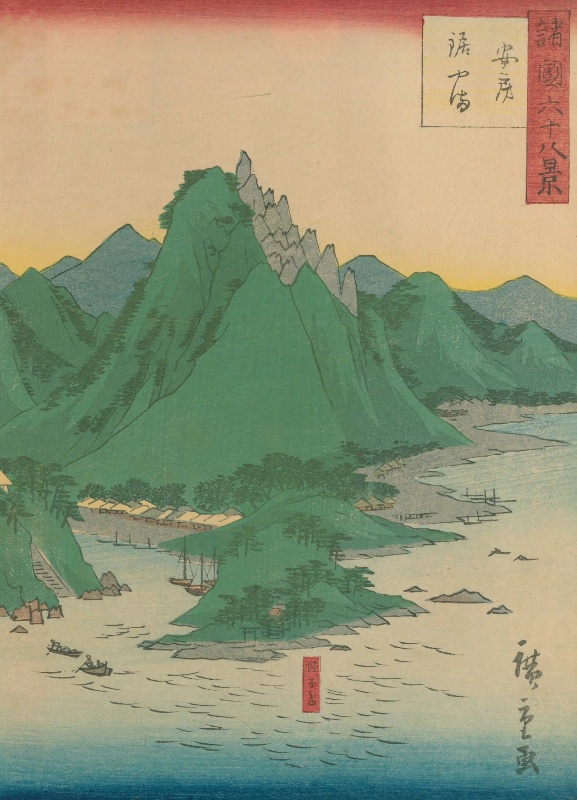
    “Awa Nokogiriyama” (NDL Gallery, public domain)

  • October

    Working as an ALT

    A couple of days before the students would return to school after the end of their summer break–and I would start working as an ALT—I purchased a really cheap notepad at Second Street. It’s a chain thrift-store spread across Japan that really puts American thriftstores like Goodwill and the Salvation Army to a level below in terms of cleanliness, organization, and the wide arrange of items they sell. I have brought that notepad to all three schools whenever I work. It’s purpose was to take notes usually at the end of the work day. After teaching anywhere between four to six classes on average, and being in a totally new cultural and working environment, I had lots to say. The typical 5×5 inches really made me selective with what to jot down. Each page or each note was for that day so I tried to write with intention. Here are some examples:

    9/3/25

    • six classes
    • students asked so many questions
    • day goes by faster

    9/29/25

    • 3rd floor
    • no breaks in between first and fourth class

    I find the notes on September 11th the most interesting, however. And that is what this blog entry will be focused on.

    9/11/25

    • calm presence, be consistent
    • hold the space
    • I’m excited for Saturday

    What did I mean by calm presence and be consistent and hold the space? The date when this note was written indicates that I had been an ALT for less than two weeks, so clearly, I had thought about this for a while.

    What is a Boddhisattva?

    I couldn’t find a smooth transition from the previous topic into this so I thought I’d write this as it is. In Buddhism, there is a concept of a Boddhisattva. To put it simply, it is a being who has achieved enlightenment, therefore, they have escaped the cyle of life, death, and rebirth (samsara in Sanskrit). But rather than choosing to leave the cycle, they selflessly choose to stay in the cycle for the sole purpose of helping ALL sentient beings in alleviating suffering and working towards the remarkable goal of all beings, one day, achieve enlightenment. This motivation is companioned by immense amount of compassion (Boddhichitta) that serves as the driving vehicle. Now what does all of this have to do with what I wrote about being an ALT and the notepad idea?

    The Connection

    Having been raised as a Buddhist in the Vajrayana tradition, the concept of a Boddhisattva has always been a fascinating and ever so recently now that I have been teaching English through a TEFL framework for the past couple of years. As a teacher, in any capacity, whether as a part-time tutor to a tenured and distinguished professor, we hold insurmountable responsibility as educators. The students, our beneficiaries, are what gives purpose to the teachers. Without students, there would be no teachers. Just as a Boddhisattva would think, ALL sentient beings are their students. From a grasshopper to a bull to a human being. Just as a teacher might use a textbook or a chalkboard to get their thoughts across the students, a Boddhisattva uses universal compassion and the desire to free all beings from suffering. Now in no way or form, am I implying that I am a Boddhisattva. Hardly ever. I have my fair share of probelms to deal with. People who I think, historically, that were Boddhisattvas or cultivated Bodhichitta are people like Mandela, the Dalai Lama, and Jesus Christ. Of course, I can never put my name in the same realm of the people I just mentioned, but what I can do is take small cups of compassion and apply it with a specific group of people or do it when it truly matters, and in this case, in the classrooms of Japanese schools as an ALT.

    In the Classroom

    Upon entering the different classrooms, I always take three quiet but deep breaths. It centers me and allows me to channel my energy to the students and the teacher in a calm but selective manner. To me, students are the number one priority. Without students, the JET Program would not exist and so I would never ever be here presently. Whether there are five students in the classroom or upwards of 40, I don’t look at them as a whole but rather through the lens of ‘These are my students, each of them are unique and hold a story that I can learn from’.

    During the Tokyo orientation back in August, I learned that upwards of 1,500 JETs come to Japan, majority being ALTs. I know that there are ALTs who are deeply extroverted. They will bring immense amount of energy in the classroom from dancing, singing, orchestrating games, to remembering each of the student’s names like their lives depend on it. And to the other side of that coin, I know there are ALTs who have a quiet and reserved energy. I am on that side of the coin. With the lack of high energy or spontaneity, I take into consideration of the students at an individual level. Through consistency of my self presented in the classrooms and a quiet but supportive and compassionate display of myself, teachers and students can slowly develop trust and recognition that this ALT, though reserved and perhaps a bit quiet at times, is who they say they are. I think trust is the start of a solid professional relationship with the teachers and students, and consistency plus an act of compassion and creating a supportive environment curates these ideals.

    The Journey Onwards…

    This blog entry served quite differently. It is written in a more reflective tone and ties in my background of Buddhism as well as shedding light into my character and personality. There was a stint of not writing enough, but one thing I can certainly guarantee is to write more than just the pedagological aspects of being an ALT and will delve more into the social relations as an ALT in the next coming months.

    “Winter in Kamigamo, Kyoto” by Hasui Kawase (NDL Gallery, public domain)
  • August

    Down and Moving

    Upon arriving at the Hiroshima Airport, I noticed immediate changes in my surrounding area. The weather was, still very much, hot and humid but there were strokes of gentle breeze brushing upon the air every few minutes or so. The breeze, which may be insignificant in the grand scheme of things, played a mighty role in how each day can turn out. 

    From the high rise hotels of Shinjuku, Tokyo to the large castle-like houses settled in between open rice fields, Hiroshima offers something different. A calm sense of peace entwined with structure and formalities, I guess you can say this to most parts of Japan already. 

    I was greeted by a couple of staff from the Board of Education (BOE) and current ALTs from the city of Higashihiroshima. From there on, a series of tasks were to be completed. A visit to the city hall to register our names and address followed by the bank and to wrap up the day, settling into my apartment. 

    Situating

    I thought I knew the heat and was prepared for it when I arrived in Japan, but I was extremely wrong. My travels to warm weather countries like Armenia and India as well as living in dry climate cities like Las Vegas did not prepare me at all. It is a different kind of heat here. The humidity is relentless and on most days as I have been working on this blog, I have been sheltering inside as if I am allergic to the sun. I’ll have to wait until the end of September to feel the weather cooling. 

    Things slowly started to connect for me. It wasn’t too long before I visited all the three schools that I would be teaching at and started to understand the cultural etiquettes in schools such as switching from outdoor to indoor shoes once entering the school premise, to the students dedicated to cleaning during breaks. These are the basic first impressions I got from visiting the schools, and as I start working in the first week of September when all the students come back after their summer breaks, I look forward to digging deep into understanding more and more about the Japanese culture in schools. 

    Speaking of school, the new first year ALTs in the Hiroshima prefecture were asked to attend a five-day language camp at a training center in Higashihiroshima. Though it is a language camp, many ALTs also call it friendship camp, as it gives ample time both in and out of the classroom to be acquainted with other ALTs. There was a sizable group of first years, some having studied Japanese for more than a few years and some, like me, only knowing a few phrases. The Japanese language instructors divided the group into classes ranging from A to E. A being the absolute beginners to E being the most advanced. You can guess which class I was in.

    The Hiroshima Orientation

    The language camp was not one of the last things on the to-do-checklist for the end of August. There was one last task to do. Attend the three day orientation in Hiroshima City. 

    Orientations, in general, are not my thing. Specifically because it involves dozens of people or in this case, over 150 participants from all over the prefecture in a giant room. I looked at this orientation very much similar to the one in Tokyo but more focused on Hiroshima. Three days can feel like three weeks or maybe even just a few hours depending on the person you talk to. But on the positive side, the orientation was very much enjoyable. Sure there were a few hurdles I might have missed early on, but I was in full stride towards the middle of the race and at the end, I felt like every single person that I met at the orientation shared a strong bond over the journey and experiences here in Japan. 

    I explored more of Hiroshima City outside of the orientation. From visiting Miyajima Island late at night to having a few drinks with friends at a cozy quiet bar waiting to be discovered, I found pleasure in balancing work and fun, something that is very much a catalyst to having a JET Program experience.

    “Suo-Kintai Bridge” by Hasui Kawase (NDL Gallery, public domain)
  • The First Day on the Job

    The Flight

    The flight duration from The San Francisco International Airport to Narita International Airport in Tokyo, Japan was nine hours and fifty-nine minutes long. I can get used to both flights that are short and long. Short flights, to me, are anywhere between one to six hours and long flights are anything above twelve hours. But this flight specifically was somewhere in the middle and my mind and body couldn’t figure out whether to sleep or stay awake throughout the flight, as apparently, doing both was near impossible.

    Like the flights to Yerevan from New York City back in March 2023, all of the San Francisco JET Program participants were seated together. I was assigned a middle seat between two guys that easily towered over me with their ‘six-feet plus’ frames. Our conversations spontaneously jumped between travels, hopes & ambitions, to more nuance topics like Japanese aesthetics and prefecture placements.

    Arrival

    Upon arrival to Narita International Airport, we were immediately directed by staff members and volunteers from the JET Program. Navigating through the airport terminal from customs & immigration to baggage claim to ground transportation felt like a participant in the TV-show The Amazing Race or going through a corridor maze surrounded by glass panels, TV screens, and white tiles.

    After the hectic push through the airport, one of many bus limousines pulled us in and drove us to the famous Keio Plaza Hotel. This hotel has served as the designated accomodation hotel for the orientation that the JET Program participants had participated in for decades. By the evening, a handful led to dozens, then hundreds all in a matter of hours. The San Francisco JETs were now walking or sitting shoulder-to-shoulder with others from Miami, Detroit, Canada, and eventually, the rest of the international JETs.

    From Here On Out

    From here on out, half of the orientation has concluded. The sessions ranged from Japanese laws and customs to managing mental health to short team-teaching exercises. These sessions and keynote speeches has definitely been both enriching and exhausting. Over 1,200 first year JETs like myself have arrived to Japan. As part of the group B orientation, sitting down in endless rows of chairs felt chaotic and calming. With over 600 JETs all sitting in the large auditorium, it can be chaotic sifting through people to use the restroom or the water station, but it can also be calming as I am surrounded by so many like-minded individuals who share the same level of interest in Japan and teaching.

    Today, August 4th 2025, marks the third day of the orientation and tomorrow, I will be flying to Hiroshima to begin my real first day on the job.

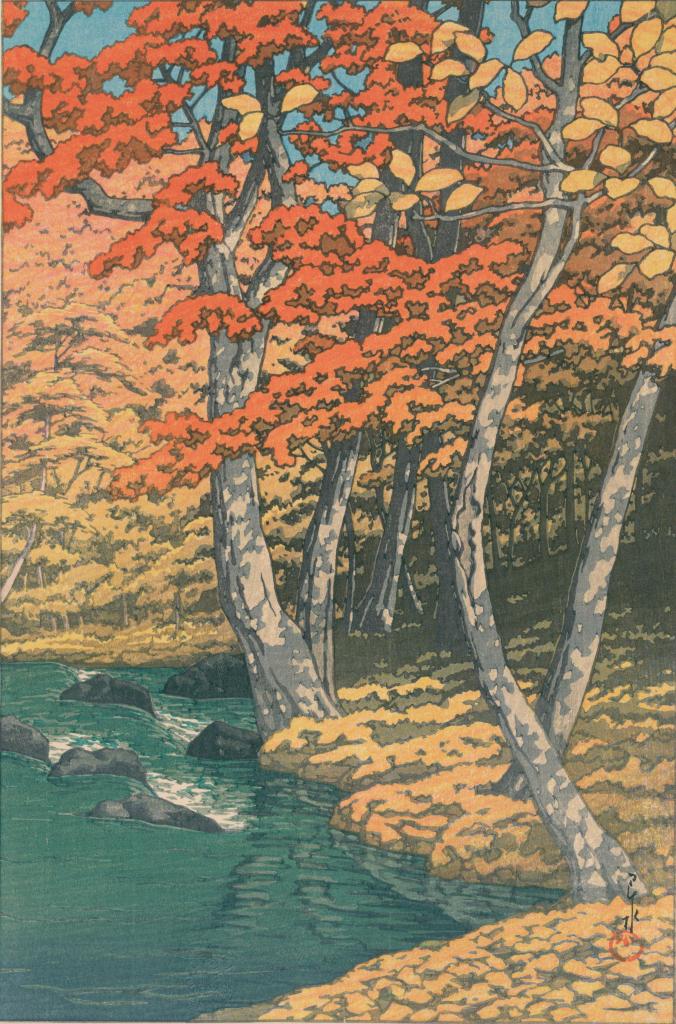
    “Autumn in Oirase” by Hasui Kawase (NDL Gallery, public domain)